
© af
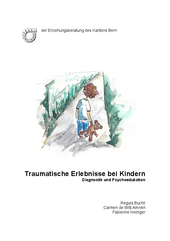
Traumatische Erlebnisse bei Kindern - Diagnostik und Psychoedukation
Die aktuelle weltpolitische Lage führt dazu, dass immer mehr potentiell traumatisierte Kinder der Unterstützung von Fachleuten – auch in der psychologischen Grundver- sorgung - bedürfen. Traumata können bei Kindern aber auch durch Hospitalisatio- nen und damit verbundene medizinische Eingriffe, Unfälle o.ä. ausgelöst werden, wie im Folgenden beschrieben wird.
Die Diagnose von Traumafolgestörungen bei Kindern ist durch die Tatsache er- schwert, dass sie eine Reihe unspezifischer und altersabhängiger Symptome zeigen, die auch bei anderen Störungen auftreten, was unter Umständen zu Fehldiagnosen (ADHS) führen kann.
Aus diesem Grund hat die vorliegende Arbeit zum Ziel, Fachpersonen eine Zusam- menstellung grundlegender Informationen zur Entstehung und Diagnostik von Traumafolgestörungen sowie einen Überblick über gängige Diagnoseinstrumente zur Verfügung zu stellen.
Da wir uns bewusst auf die Erstversorgung von traumatisierten Kindern beschränken, stellen wir in einem zweiten – praktischen Teil – mögliche Vorgehensweisen bei der Psychoedukation von traumatisierten Kindern und ihren Eltern sowie Stabilisierungs- techniken vor.
Dokument herunterladen
(pdf ǀ 7 MB)nicht gedruckt verfügbar
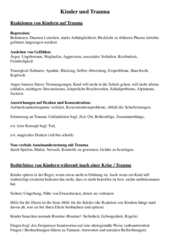
Ein Leitfaden: Kinder und Trauma
Reaktionen von Kindern auf Trauma
Bedürfnisse von Kindern während/nach einer Krise/Trauma
Wann brauchen Kinder professionelle Hilfe
Dokument herunterladen
(pdf ǀ 71 KB)nicht gedruckt verfügbar
Ratgeber für Flüchtlingseltern: Wie helfe ich meinem traumatisierten Kind?
Sie sind aus Ihrer Heimat geflüchtet, vielleicht weil sie zerstört war oder dort Krieg ge- herrscht hat. Sie haben Ihr Zuhause verlassen, in dem Sie mit Ihrer Familie gelebt hatten. Sie sind oft auf sehr beschwerlichen Wegen nach Deutschland gekommen.
Sie sind geflohen, weil Sie möglicherweise Ihr Leben und das Ihrer Kinder bedroht sahen. Auf der Flucht war vieles sehr schwierig. Wer solche Unsicherheit erlebt, trägt manchmal noch lange die Erinnerungen daran mit sich herum. Vor allem die Bilder von bedrohlichen Ereignissen sind nicht einfach zu vergessen. Die Angst, die damit verbunden war, steckt noch im Körper und in der Seele.
Das ist normal. Das geht allen
Menschen so. Aber manchmal
leben die Erinnerungen weiter und
weiter.
Dokument herunterladen
(pdf ǀ 251 KB)nicht gedruckt verfügbar

John Leverington, Children and Trauma
Crisis events such as natural disasters, violent acts and serious accidents are frightening to children and adults. It is important for parents, teachers, hostel parents and other care takers of children to know how a crisis can effect children and how to help them deal with the trauma. Children who experience an initial traumatic event before they are eleven years old are three times more likely to develop psychological symptoms than those who experience their first trauma as a teenager or later. Children’s ability to deal with a traumatic event is primarily dependent on the reaction of the parent or those people who are in a care-taking role, such as school personnel or hostel parents.
Dokument herunterladen
(pdf ǀ 119 KB)nicht gedruckt verfügbar
Helping Children in the Midst of Crisis (Some Don'ts and Do's)
These suggestions are taken from pp 165-176 in Sojourners” The Family on the Move, A Book of Resources by Ruth J. Rowen & Samuel F. Rowen (1990). Farmington, Michigan: Associates of Urbanus.
Dokument herunterladen
(pdf ǀ 68 KB)nicht gedruckt verfügbar

Psychological first aid: Guide for field workers (2011)
When terrible things happen in our communities, countries and the world, we want to reach out a helping hand to those who are affected. This guide covers psychological first aid which involves humane, supportive and practical help to fellow human beings suffering serious crisis events. It is written for people in a position to help others who have experienced an extremely distressing event. It gives a framework for supporting people in ways that respect their dignity, culture and abilities. Despite its name, psychological first aid covers both social and psychological support.
Dokument herunterladen
(pdf ǀ 1 MB)nicht gedruckt verfügbar

Trauma Information for Parents
Children who experience a trauma (such as a car accident) have reactions that may include denial, fear, anger, guilt, sadness, and confusion. These reactions are part of the normal recovery process. You can help your child by showing acceptance of her feelings, reassuring her that she is safe now, and by being consistent with your discipline and expectations, so that she will feel secure. You may observe some of the following behaviors:
Dokument herunterladen
(pdf ǀ 78 KB)nicht gedruckt verfügbar

Trauma-first-aid-english
We hope that information and education about the effects of traumatic exposure accompanied by appropriate primary help will contribute to dissolving the traumatic shock of so many people more quickly, so that it does not end in despair or violence. And that among the migrants themselves in the long run resources can be set free to help prevent humanitarian catastrophes of this dimension. May we all continue to believe in humanness and healing.
Dokument herunterladen
(pdf ǀ 311 KB)nicht gedruckt verfügbar
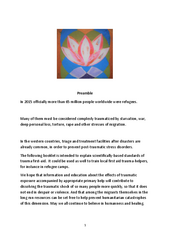
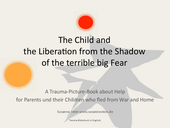
The Child and the Liberation from the Shadow of the terrible big Fear
Dokument herunterladen
(pdf ǀ 4 MB)nicht gedruckt verfügbar
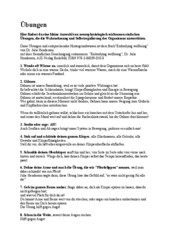
Übungen: neurophysiologisch, wirksam, einfach
Hier findest du eine kleine Auswahl von neurophysiologisch wirksamen einfachen Übungen, die die Wahrnehmung und Selbstregulierung des Organismus unterstützen.
Dokument herunterladen
(pdf ǀ 98 KB)nicht gedruckt verfügbar
Aktuelle Gesetzgebungsverfahren:
-
Geordnete-Rückkehr-Gesetz: Offener Brief an die Abgeordneten des Deutschen Bundestage vom 2. Juni 2019
-
Bundesministerium des Innern, für Bau und Heimat: Fragen und Antworten zum Entwurf des "Geordnete Rückkehr Gesetzes"
-
"Geordnete-Rückkehr-Gesetz": Offener Brief gegen Abschiebegesetz (ARD Tagesschau vom 30.05.2019 - 11:05 Uhr)
-
"Geordnete-Rückkkehr-Gesetz": Wie praktikabel sind Seehofers Abschiebepläne? (ARD Tagesschau 16.05.2019 - 03:27 Uhr)
-
Entwurf des Innenministeriums: Das steht in Seehofers Abschiebegesetz (ARD Tagesschau 17.04.2019 - 15:16 Uhr)